Updates and announcements from Dartmouth-Kalaniyot
We are delighted to welcome Prof. Mark McPeek (David T. McLaughlin Distinguished Professor of Biological Sciences) and Prof. Marnie Halpern (Andrew Thomson, Jr., MD 1946 Professor; Chair, Department of Molecular and Systems Biology) to the Dartmouth-Kalaniyot in the Sciences (DKS) Advisory Board. Both bring distinguished records of scientific leadership and broad expertise in the life sciences, and we look forward to their guidance on DKS programming and strategy.
We are pleased to announce a new pilot program: a handful of competitive Kesher Grants will award $5,000 grants to support a one-week visit to Israel to initiate new scientific collaborations. Requirements are a cv, a one-page letter describing the rationale for the visit (e.g., anticipated areas of connection), a letter of invitation from (at least) one potential collaborator at an Israeli research institution for a visit that will include a presentation and a schedule of integrative activities. Details may be found here. Our next deadline for proposals is April 15, 2026 for travel at any time before April 14, 2027.
We welcome our new Administrative Assistant, Jennifer Thomas. Jennifer formerly was the Administrative Assistant for Dartmouth's Jewish Studies Program and Program in Mid-East Studies, and we are grateful to have someone well-versed both in Dartmouth and Israel and the broader region.
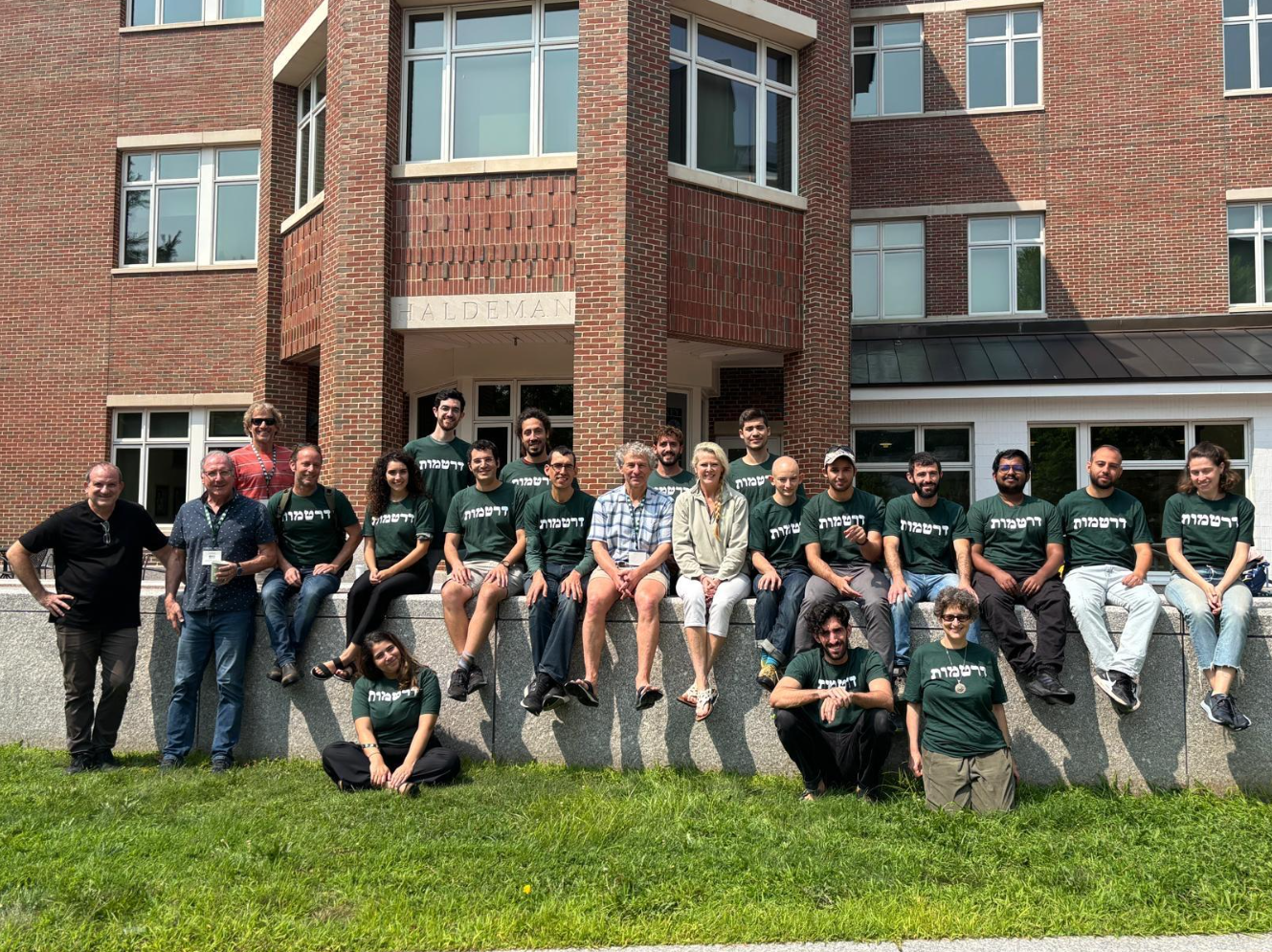
This past summer, Dartmouth Kalaniyot Director Dan Rockmore, in collaboration with colleagues from Tel Aviv University (TAU), launched a new Dartmouth-TAU summer school program at Dartmouth College. The 2025 program brought together faculty, postdoctoral fellows, and graduate students from both Dartmouth and TAU for an immersive ten-day exploration of the urgent issue of climate change and its global impacts, examined through the joined lenses of computation and complex systems. The school was jointly supported by the Dartmouth Kalaniyot in the Science program, Dartmouth's Neukom Institute for Computational Science, and Tel Aviv University's Office of International Academic Affairs. Twenty students and faculty from TAU visited Dartmouth.
The workshop provided a unique platform for students to learn from leading experts, share their own research, and engage in cross-disciplinary discussions with peers and faculty members. As the effects of climate change continue to intensify around the world, the program offered participants valuable insight gained through novel data analytic techniques, into how a warming planet is reshaping weather patterns, ecosystems, and human societies.
Throughout the workshop, students attended lectures and discussions led by speakers from both institutions. Topics included:
The workshop included a field excursion to the Hubbard Brook Experimental Forest, where students observed long-term climate research in action.
By fostering collaboration between Dartmouth and Tel Aviv University, this inaugural workshop not only deepened scientific understanding of climate change but also strengthened international academic partnerships—empowering the next generation of scholars to address one of the world's most pressing challenges.
Read More →
Dartmouth College recently welcomed Dr. Assaf Shmuel, a postdoctoral fellow supported by the Israeli Council for Higher Education Fellowship for Climate Scientists. Dr. Shmuel works with Prof. Ron Milo at the Weizmann Institute of Science (Israel) and Prof. Carl Schleussner at IIASA (Austria). He holds doctoral degrees in Computer Science, Geophysics, and Political Science, and his interdisciplinary research applies machine learning to deepen understanding of climate dynamics.
During his visit to Dartmouth—supported by Kalaniyot and the Department of Mathematics Shapiro Visitor Program—Dr. Shmuel is collaborating with Prof. Justin Mankin to investigate an intriguing question: Why does observed climate change tend to evolve at a roughly linear rate, despite sharp increases in greenhouse gas emissions in recent decades? The project compares simulations with observational data and examines how datasets, definitions of acceleration, and regional-to-global relationships shape scientific interpretations of climate acceleration.
Dr. Shmuel's visit highlights Dartmouth's commitment to fostering international collaboration and advancing the science of climate change.
On November 17, 2025 we closed on our first set of proposals in Dartmouth Kalaniyot's first RFP for our Collaborative Ventures in the Sciences program. We are delighted by the response to this program which will fund a number of proposals in the sciences. Each project will have a PI from Dartmouth and a PI from an Israeli research institution and budgets are capped at $50,000.
For this first call we received over 20 proposals, ranging across Engineering, psychological and brain sciences, biological sciences, mathematics, physics and astronomy, biomedical data science, chemistry, computer science, biochemistry and cell biology, environmental studies, earth sciences, and clinical medicine. PIs at Israeli universities come from TAU, Hebrew University, Ben Gurion University, the Weizmann Institute, Bar-Ilan University, and Ariel University. Both TAU and BGU are providing some supplemental funding.
We look forward to announcing the inaugural group of recipients some time in December.